How to Approach Tewksbury Equestrian Property Selling
June 25, 2026
June 25, 2026
If you are selling an equestrian property in Tewksbury Township, you are not just selling a house with acreage. You are selling a working horse property in a town with a clear equestrian identity, where buyers pay close attention to land use, barn function, trail access, and day-to-day usability. When you understand what those buyers are looking for, you can position your property more clearly, avoid common missteps, and create a stronger path to a successful sale. Let’s dive in.
Tewksbury Township has a well-established equestrian culture. The township notes more than 100 miles of trails, and Hunterdon County identifies riding opportunities in places like Cold Brook Preserve, where riders can access about 2 miles of farm-road riding near the fields. For sellers, that means horse use is not a side note. It is often a core part of the property’s value.
This also sits within the larger Hunterdon County market, where farming and open land remain a major part of the landscape. County planning resources state that more than 120,000 acres in the county are farmland-assessed, accounting for about 44 percent of county land, and horse farms remain popular. In practical terms, buyers here often compare properties based on function, stewardship, and layout just as much as home finishes.
Horse-property buyers usually assess how well the property works before they focus on cosmetic details. They are thinking about how horses move through the site, how the land holds up in wet weather, and whether the setup supports everyday care without constant workarounds. That makes property flow a major selling point.
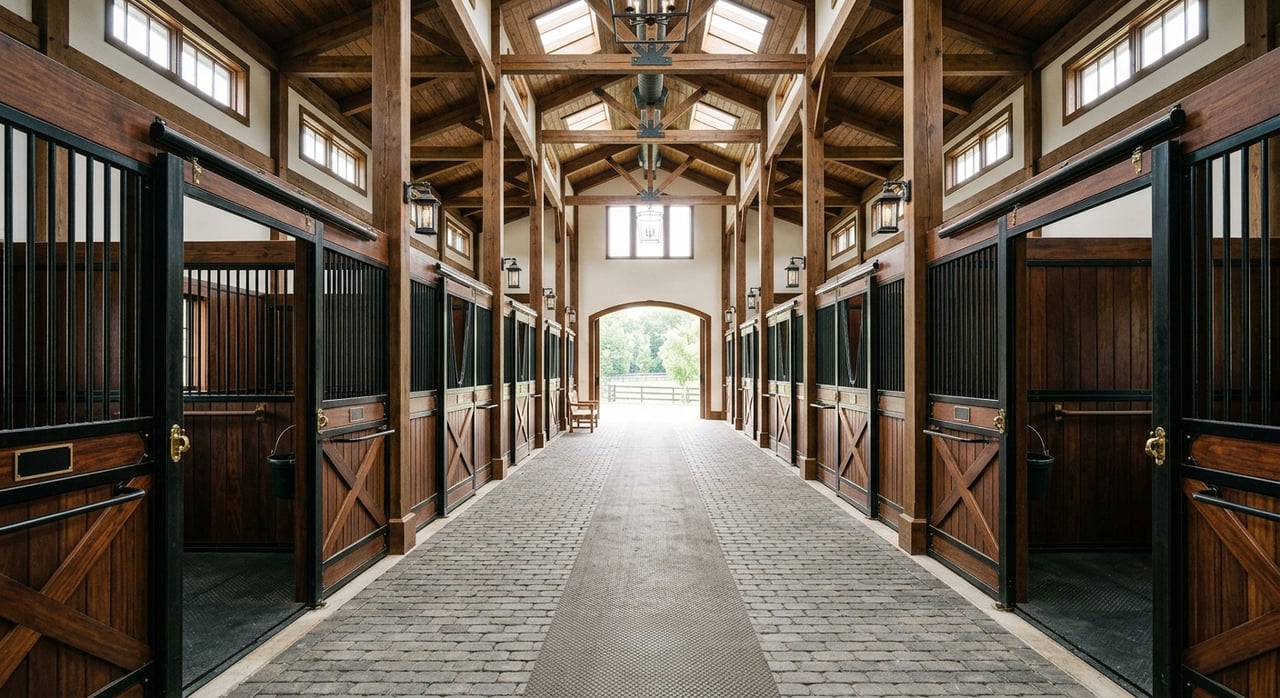
A barn should feel organized, practical, and easy to maintain. Buyers often notice aisle width, stall condition, storage, wash areas, and whether service spaces feel intentional rather than improvised. In Tewksbury, where the development code recognizes barns as accessory buildings tied to agricultural use, the setup should also make sense within the broader use of the property.
Manure handling matters too. New Jersey’s equine agricultural management practice ties manure management to required compliance standards and an approved farm conservation plan where applicable. Even if buyers love the setting, they may become cautious if the service side of the barn area appears disorganized or unclear.
Raw acreage alone rarely tells the whole story. Buyers usually want to see usable turnout, healthy pasture areas, and a layout that supports rotation and limits mud around gates, feeders, and barn exits. These details help show that the land is working well for horses, not just measuring well on paper.
New Jersey’s equine agricultural management practice states that pasture regimes should maintain at least 70 percent vegetative cover, with stocking rates influenced by horse size, turnout time, drainage, soil type, weather, and pasture yield. That means a well-managed property can often present better than a larger one with worn footing and overused fields.
An arena is a major value point, but only when buyers feel it is truly usable. They will look at drainage, footing quality, dust control, and the condition of the perimeter as closely as they look at the riding space itself. If the arena rides well after rain and appears consistently maintained, that can make a strong impression.
State equine guidance says riding and training areas should be located in well-drained areas. It also notes that manure, straw, and shavings should not be placed in arenas, and that dust control should rely on methods like watering or vegetative buffers. Those practical details can shape how buyers judge long-term maintenance.
Fencing is not just a visual feature. It affects safety, circulation, maintenance, and daily use. Buyers often notice whether gates are placed logically, whether paddocks connect efficiently to the barn and turnout areas, and whether trailers can enter, turn, and park without difficulty.
New Jersey’s equine practice allows fencing around pastures, exercise areas, equine facilities, water bodies, and dangerous areas, and it calls for enough setback from property lines to support repair and maintenance. It also states that non-electric horse fences should be between 4 and 8 feet high. A clean, functional fencing system can support value in a way standard listing photos often miss.
Tewksbury sits in the New Jersey Highlands region and is fully conforming to the Highlands Regional Master Plan. According to the Highlands Council, the township includes 13,469 acres in the Preservation Area and 6,857 acres in the Planning Area. For buyers, that often raises important questions about what can be expanded, cleared, rebuilt, or paved.
That does not mean a property is less desirable. It means buyers want clarity. If your property includes barns, paddocks, arenas, open fields, or wooded acreage, a strong sale strategy should help explain what is existing horse infrastructure and what may be affected by Highlands or local land-use constraints.
Tewksbury’s development code is also helpful context. It broadly defines agriculture to include breeding, boarding, raising, rehabilitating, training, or grazing horses, ponies, mules, or goats. The code also notes that horse keeping or boarding on single-family residential lots may be treated as an accessory use in certain districts, which makes zoning verification a smart step before listing.
The best equestrian listings do more than look beautiful. They answer the practical questions serious buyers will ask. Preparation should focus on both presentation and documentation.
Your goal is to show that the property works smoothly. Clean barn aisles, tidy tack and feed areas, neat wash spaces, trimmed fence lines, and dry, well-kept turnout areas help buyers picture daily life on the property. These details also suggest thoughtful ownership.
It helps to show clear travel paths from driveway to barn, barn to paddocks, and paddocks to arena. Buyers often respond well when the layout feels easy to understand and easy to operate.
Before listing, assemble a property file with the records buyers are likely to request. This can help reduce uncertainty and make due diligence more efficient once interest picks up.
Useful documents may include:
If the property operates as a farm or equine facility, buyers may ask how manure is stored and managed. The New Jersey Department of Agriculture states that all livestock farms, including equine operations, must follow general animal-waste requirements, and that certain farms must develop and implement an Animal Waste Management Plan. It also states that manure storage areas must be at least 100 feet from waters of the State and located on slopes under 5 percent.
Farmland Assessment can affect how a property is viewed and how future plans are discussed. Hunterdon County states that the Application for Farmland Assessment and Gross Sales Form must be submitted by August 1. The state tax agency also notes that roll-back taxes can apply if land use changes from agricultural or horticultural use to non-farm use.
If your property currently benefits from Farmland Assessment, it is wise to confirm that status before marketing changes or use changes are made. This is especially important if buyers may be evaluating the property as both a residence and a working farm.
If the property operates as a commercial farm, Right-to-Farm status is worth confirming before listing. New Jersey states that a commercial farm generally must be larger than five acres and produce at least $2,500 annually to qualify, while also complying with adopted agricultural management practices, relevant statutes, and public-safety requirements.
For an equestrian property, that can bring attention to turnout condition, manure handling, dust control, and fencing standards. Having this information organized early can make buyer conversations more straightforward.
Equestrian properties need a different marketing approach than a typical residential listing. Buyers need to understand the full layout, the relationship between improvements and open land, and the practical strengths of the site. That is why visual strategy matters so much.
Aerial photography and drone video are especially effective in Tewksbury because many of the best selling points are spatial. Buyers want to see acreage, paddock arrangement, barn placement, arena location, access drives, and surrounding open land. A polished aerial presentation helps tell that story quickly.
A simple site map or annotated survey can also add real value. Showing the barn, turnout fields, paddocks, arena, water sources, manure storage, and any trail easements or conservation boundaries helps buyers understand the property with fewer assumptions.
Ground-level photography and video should focus on condition and usability. Useful visuals include stalls, aisleways, tack storage, wash areas, fence lines, drainage swales, pasture condition, and the route for trailers and equipment. These images answer real questions that equestrian buyers typically have.
If the property benefits from nearby riding access, be precise about where riding is permitted and whether that access is private or public. Clear language builds confidence and helps avoid confusion later.
Showing plans may need a little extra thought for rural and equestrian properties. If the property is shown during hunting season or in an area used for multiple recreation types, safety considerations should be communicated clearly. Hunterdon County’s horseback-riding guide notes that some properties are used for hunting in season and suggests blaze orange or Sunday-only visits in certain contexts.
That is not about marketing drama. It is about practical preparation and safe access during showings.
Selling an equestrian property in Tewksbury is rarely a standard listing exercise. Buyers are evaluating barn function, pasture management, access, regulatory context, and land stewardship alongside the home itself. A strong sales strategy needs to reflect all of that clearly and professionally.
That is where local market knowledge and equestrian fluency can make a real difference. From pricing and presentation to documentation and buyer conversations, the right guidance helps you market the property for what it truly is, not just what it looks like in photos.
If you are preparing to sell an equestrian property in Tewksbury Township and want a strategy tailored to the land, the improvements, and the buyer pool, Gale Sauchelli can help you position it with clarity and care.
Get assistance in determining current property value, crafting a competitive offer, writing and negotiating a contract, and much more. Contact me today.